Cleaning of Propeller Blades
We deliver diver-led propeller blade cleaning for FPSOs and semi-submersibles, removing fouling to restore efficiency, prevent cavitation damage, and protect propulsion performance without costly drydock.
Key Benefits
Recover Thrust and Fuel Efficiency Without Drydock
Biofouling increases drag and power demand. Cleaning restores blade surface condition while the vessel remains on station.
Prevent Cavitation Damage and Blade Erosion
Surface fouling leads to pitting, vibration, and structural degradation. Cleaning helps preserve blade integrity and operational lifespan.
Compatible With All Major Propulsion Systems
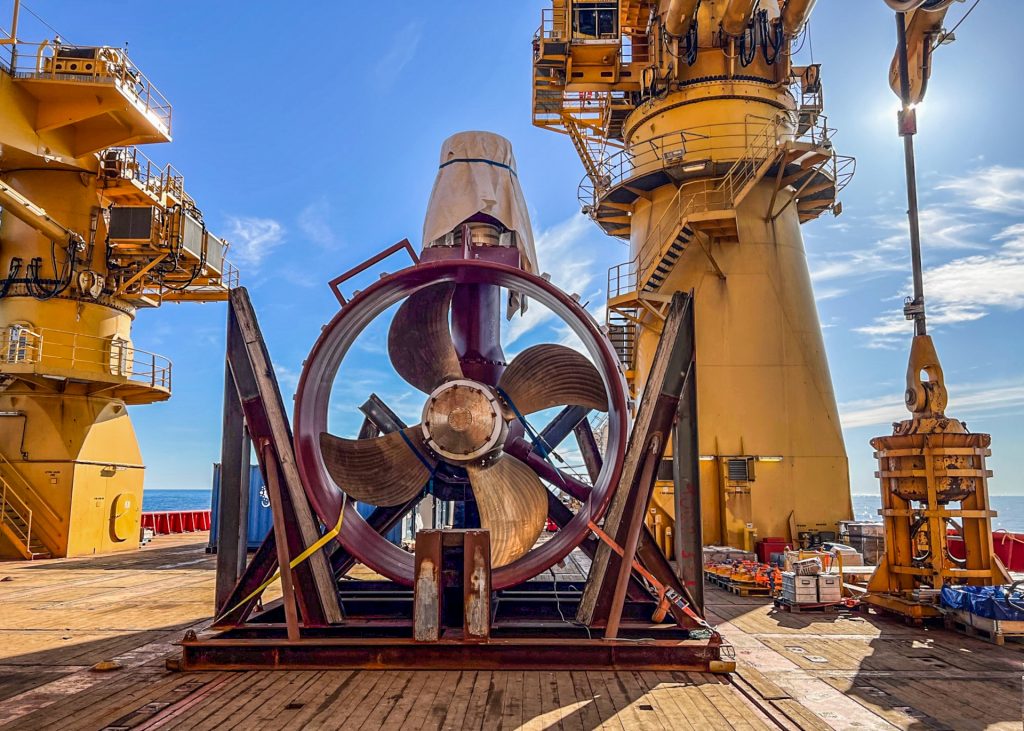
Fixed-pitch, controllable-pitch, and azimuth blades are cleaned using diver-operated tools adapted to blade geometry and material.
Service Description
We provide diver-led propeller blade cleaning for propulsion-equipped floating production systems. Over time, marine growth, corrosion residue, and surface fouling reduce propeller efficiency and increased fuel consumption. Left untreated, fouled blades also increase cavitation risk and vibration loads.
Our cleaning operations restore performance and hydrodynamic balance without unmooring or drydocking. Tools and methods are adapted to blade type, material, and fouling severity to ensure effective cleaning.
Operational Scenario
Real Results: Propeller Cleaning Restores Efficiency Without Drydock.
Challenge
Performance trends show rising fuel consumption and reduced propulsion response on a semi-submersible during station-keeping. Engineering suspect moderate fouling on fixed-pitch propeller blades, but the vessel is mid-campaign with no drydock access.
Solution
SubseaPartner deploy a diver team to clean the propeller blades in situ. Hydraulic scrubbing tools and low-pressure jetting are used to remove biofouling from blade surfaces, edges, and hub areas. Propeller blades are then polished to A/B on the Rupert scale. The operation is completed in coordination with propulsion management.
Outcome
Post clean data confirms improved thrust and reduced load. Cavitation inspection is cleared for later in the year, and no interruptions to station-keeping are required. The operator retains full propulsion readiness and avoids additional intervention costs during the current campaign.